
❋ Africa · Guardian 9 of 64
Tarika
The Banana Guardian of the Great Lakes
Banana — anchored in Great Lakes Kingdoms (Buganda, Rwanda, Congo, Tanzania, Kenya).
Addendum entry — drawn from the flashcard deck and pending review against the master compendium.
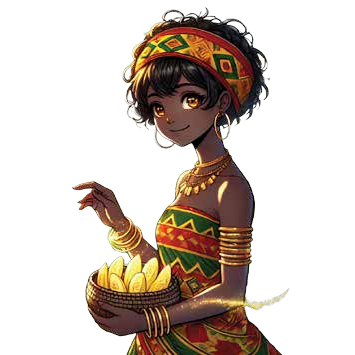
- Crop
- Banana
- Cultural anchor
- Great Lakes Kingdoms (Buganda, Rwanda, Congo, Tanzania, Kenya)
- Region
- Africa
Botanical origin vs. cultural anchor
Cultural anchor: the Great Lakes kingdoms of East Africa, where banana cultivation underwrote settlement, statecraft, and daily food security. Botanical origin lies in island Southeast Asia; this entry centers the East African cultivation systems that made the crop a staple over two millennia.
Narrative
Tarika appears where the groves are tended rather than harvested once — in the banana gardens whose upkeep is continuous and whose yield is measured in generations. Their path turns Banana into evidence of settlement, labor, and the long administration of a cultivated landscape.
Origin
Bananas have been cultivated in East Africa for over 2,000 years, sustaining the Buganda Kingdom and Great Lakes civilizations. Tarika holds that span: not a moment of introduction but twenty centuries of selection, propagation, and care that turned a transplanted crop into the ground a civilization stood on.
Notes
The banana grove is infrastructure. Perennial, propagated by sucker rather than seed, and productive year-round, it allowed dense settlement where annual grain could not — which is why the Great Lakes kingdoms grew where they did.
Final Guardian artwork pending for this character.
Add to the record
Know Banana from the inside?
If this crop has a story where you are — a name it carries, a dish it belongs to, a recipe, a season, a source we should be citing — it belongs in this record. Tarika’s entry, like every entry, is a living document: community knowledge is reviewed and incorporated into future editions.
When the collection launches
From Guardian to Garden
Nothing here is for sale yet. When the collection launches, 60% of proceeds will be reinvested directly into community-controlled programs — the split is already fixed by policy.