
✦ The Caribbean · Guardian 21 of 64
Nerissa
Breadfruit — anchored in Polynesia, introduced to the Caribbean.
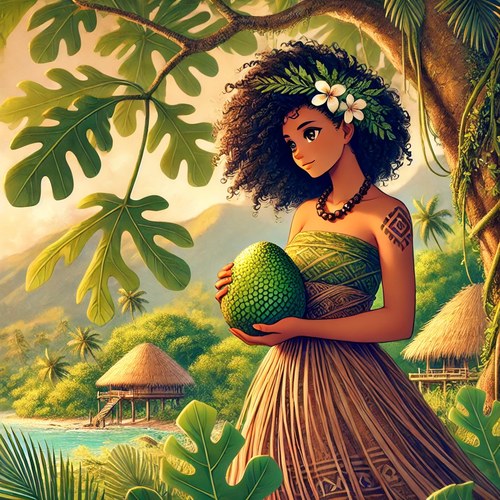
- Crop
- Breadfruit
- Cultural anchor
- Polynesia, introduced to the Caribbean
- Region
- The Caribbean
Botanical origin vs. cultural anchor
For Nerissa in the Caribbean, breadfruit is botanically tied to the Pacific/Malesian-New Guinea breadfruit complex; the cultural story centers colonial-era transplantation and later island adaptation as a major starch.
Narrative
Nerissa's route with Breadfruit is not linear. Nerissa moves between cultivation, preservation, market exchange, and household teaching, revealing how Breadfruit's origin is made through practice as much as geography.
Origin
Nerissa's story places Breadfruit in conversation with Polynesia, introduced to the Caribbean. Nerissa's task is to hold Breadfruit's routes, uses, and caretakers together without collapsing them into one simplified origin claim.
Notes
Breadfruit in the Caribbean carries the politics of colonial transplantation, then island adaptation through roasting, boiling, frying, and everyday starch use.
Add to the record
Know Breadfruit from the inside?
If this crop has a story where you are — a name it carries, a dish it belongs to, a recipe, a season, a source we should be citing — it belongs in this record. Nerissa’s entry, like every entry, is a living document: community knowledge is reviewed and incorporated into future editions.
When the collection launches
From Guardian to Garden
Nothing here is for sale yet. When the collection launches, 60% of proceeds will be reinvested directly into community-controlled programs — the split is already fixed by policy.