

Live
Shifting Landscapes
A decolonial inquiry into the interplay between land, power, policy, culture, and resistance in the creation of ecologies of knowledge that continue to transform African American urban environments.
A 501(c)(3) public charity
Through art, architecture, education, and emerging technology, Deconstructing Design helps communities reclaim narratives, reimagine space, and grow regenerative food systems rooted in justice and self-determination.
How highways, bridges, transit, and utilities encode power into physical systems — engineered landscapes as instruments of governance.
Material networks built to route movement, capital, and risk.
Spatial segregation, movement control, and governance embedded so deeply in the built form that it reads as terrain rather than decision.
Work in this layer
Public housing, zoning, Title I clearance, redlining, spatial containment, and the mechanics of displacement.
Zoning codes, clearance programs, and lending maps that assign value by geography.
Displacement, segregation, and policy-driven erasure — built form working as social sorting.
Work in this layer
How movement systems enable or restrict access — transit provision, circulation control, and borders enforced through design.
Route planning, highway alignment, and the design of who can pass through where.
Transit deserts, neighborhoods carved by highway, pedestrian suppression, policed circulation.
Work in this layer
Supply chains, extraction landscapes, agricultural control, labor systems, and diasporic culinary migration and memory.
Colonial production systems and the labor arrangements that made them profitable.
Nutritional inequity in the present, and cultural diffusion carried by the people who were moved.
Work in this layer
Environmental burden, flooding, infrastructure neglect, resource governance, and hydrological infrastructure inequity.
Utility investment decisions and drainage engineering that concentrate risk.
Climate injustice, uneven water access, urban heat, and utility inequity borne by the same neighborhoods each time.
Work in this layer
Sound is not background. Sound is infrastructure without walls.
Zoning, redlining, and containment draw lines that sound does not observe.
Music as territorial crossing; spirituals, jazz, hip-hop, and protest chant as spatial disruption; sonic memory held in neighborhoods; ancestral sound as survival infrastructure.
Work in this layer
The thesis, made visible
Every layer above was put there by a decision — a zoning code, a lending map, a route alignment, a supply chain. Reckoning in Pixels holds a rule about how those decisions get shown: a composition must reveal both the structural force and the human or spatial consequence. Never one without the other.
Select a layer to cut into it.
“No single-sided hero imagery. Both must coexist in the composition.” — RIP methodology, first principle.
Why it is drawn this way
The thesis is drawn as strata, not as a wheel. Strata imply depth, sequence, and the fact that what is on the surface was put there by something underneath — which is the argument.
The method is drawn as a closed loop, because a cycle with one way in is what a rule is: every project enters at the same principle, passes through all five before release, and the next project enters there again. What the work takes in, it returns — the same logic that governs how it treats the communities it comes from.
The core concept
A record is not the same as knowledge, and knowledge is not the same as the capacity to act. These are the three terms the work moves between.
One record, three readings. Select a term to read it.
What gets measured becomes visible. What is never collected can disappear from view.
Data records the conditions around us: where resources move, how places change, what systems produce, and who experiences their consequences. But data is not simply found. It is collected, classified, institutionalized, stored, and controlled. What gets measured becomes visible. What is never collected can disappear from view.
Information alone is not knowledge.
Information alone is not knowledge. Access means more than finding data. It means having the tools, time, resources, and expertise to collect it, question it, interpret it, visualize it, and place it in context. It also means having the power to create new evidence when existing systems fail to record what communities already know.
Understanding a system is only the beginning.
This is where Deconstructing Design works. We collect, research, map, visualize, and translate data across architecture, art, science, and storytelling. We connect institutional records with lived experience, uncover relationships that individual datasets can hide, and transform complex information into public knowledge. Because understanding a system is only the beginning. The goal is agency: stronger evidence, clearer tools, and greater capacity to question what exists and imagine what comes next. Research becomes maps, visualization, architecture, art, narrative, and public understanding, building the capacity to act.
The body of work
Not plans — finished things. A nonlinear documentary, a video experience, a published StoryMap, a character compendium, and a participatory design study.
Live
A decolonial inquiry into the interplay between land, power, policy, culture, and resistance in the creation of ecologies of knowledge that continue to transform African American urban environments.
Live
The past never really leaves us. It pulses beneath our present, not just as a memory but as a force that shapes who we are today. Themes of struggle, identity, and resilience are carried forward across generations, creating a continuous narrative that refuses to be silenced.
Published
Brooklyn stands at the epicenter of urban displacement, gentrification, and state-sanctioned land dispossession in New York City. This project investigates how Brooklyn, more than any other borough, became the testing ground for development strategies that devalue Black life and extract Black wealth under the guise of progress.
In development
Demystifying Food Origins uses character design, agricultural history, and regional storytelling to reconnect fruits, vegetables, grains, roots, and tree crops to the people and places that sustained them. It treats food as cultural evidence while distinguishing botanical origin, cultural anchor, crop movement, and artistic interpretation.
Published · 2022
A pilot program addressing lack of access to healthy foods, green spaces, and vulnerability to heat in New York City’s most affected areas — co-designed with public schools, students and faculty, community gardens, private businesses, and municipal organizations.
How the work lands
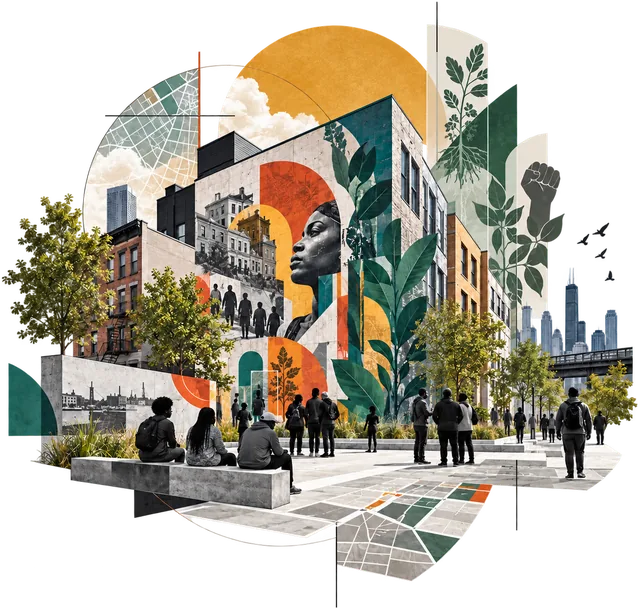
Site-specific installations that surface community narratives, environmental justice, and histories of displacement.
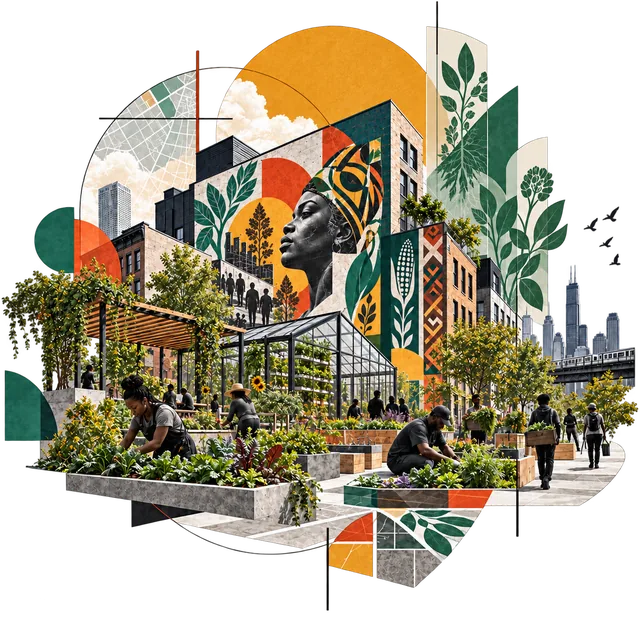
Community-controlled food production and arts-based placemaking — living canvases for cultural storytelling.
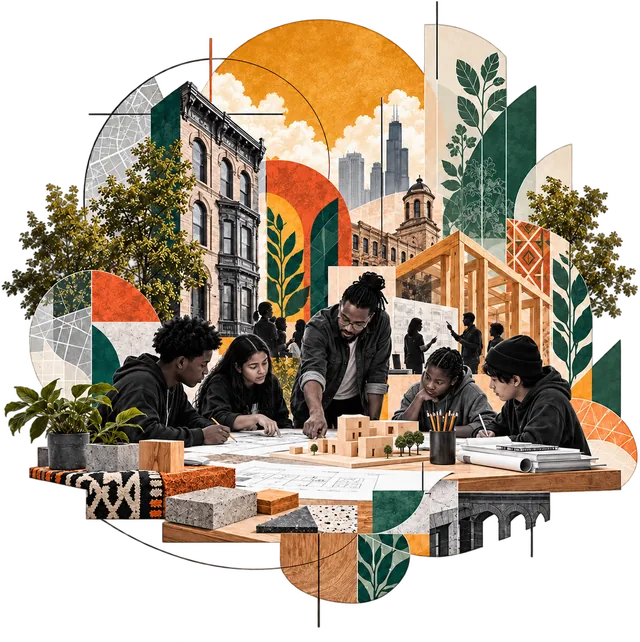
Hands-on design thinking, sustainable material use, and cultural preservation with schools and community groups.

Our intellectual and critical design project — essays, digital works, and the framework behind everything.
Mission
Deconstructing Design, Inc. is dedicated to dismantling systemic inequities by reimagining and reshaping structures that uphold injustice. Through arts, architecture, education, and sustainability, we empower marginalized communities to reclaim spaces, amplify voices, and create new frameworks rooted in justice and resilience.
We envision a world where design and creativity serve as tools for equity, cultural preservation, and community-led transformation.
Get involved
Community-controlled means you shape the work — not just witness it.
Support, at your own pace
That is why there are two quiet doors: enter the Founding Archive once and be in the record, or follow the research on Patreon, where it is told as stories to listen to and published as materials to take. Entry begins at ten dollars, and no tier is ever closed.
