✿  Region · 8 guardians

Australia & Oceania

Voyaging crops, bush foods, and Pacific agricultural exchange across ocean distances.

Kakadu Plum Kara Northern Australia (Aboriginal land)

Botanical vs. cultural: Botanical/cultural frame: northern Australian bush-food ecologies and Aboriginal knowledge systems.

Narrative: Kara's route with Kakadu Plum is not linear. Kara moves between cultivation, preservation, market exchange, and household teaching, revealing how Kakadu Plum's origin is made through practice as much as geography.

Origin: Kara's story places Kakadu Plum in conversation with Northern Australia (Aboriginal land). Kara's task is to hold Kakadu Plum's routes, uses, and caretakers together without collapsing them into one simplified origin claim.

Notes: Kakadu plum is small, sharp, and potent. Its value depends on Aboriginal ecological knowledge and northern Australian seasonal practice.
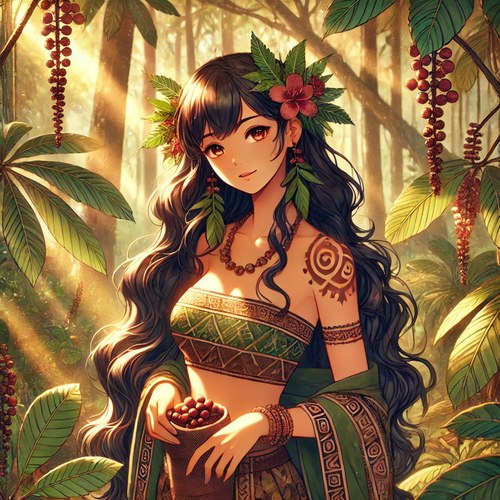

Macadamia Nut Malia Australia (Queensland, New South Wales)

Botanical vs. cultural: Botanical origin: eastern Australia, especially southeast Queensland to northeastern New South Wales; cultural anchor: Aboriginal knowledge and later global nut-crop expansion.

Narrative: In the Demystifying Food Origins universe, Malia appears in reef-to-ridge gardens when Macadamia Nut is ready to be gathered, cooked, stored, or remembered. Their path turns Macadamia Nut into evidence of climate, care, and cultural decision-making.

Origin: Malia's first scene begins with a tree canopy, a season of ripening, and the long memory of orchards or groves. The guardian is anchored in Australia (Queensland, New South Wales), but the story keeps origin open enough to include migration, exchange, and local stewardship.

Notes: Macadamia's global luxury image sits on older Aboriginal knowledge of eastern Australian rainforest trees and nut processing.

Quandong (Native Peach) Quilla Australia (Outback & Coastal)

Botanical vs. cultural: Botanical/cultural frame: Australian native fruit adapted to arid and semi-arid environments; this entry aligns origin and cultural anchor.

Narrative: Quilla's story follows Quandong (Native Peach) through dryland harvest sites, where taste is inseparable from land use, season, and inherited technique. The guardian asks viewers to see Quandong (Native Peach) as an archive of choices made across generations.

Origin: For Quilla, origin is not a single discovery moment. It is a chain of growers, cooks, seed keepers, and landscapes that made Quandong (Native Peach) meaningful in relation to Australia (Outback & Coastal).

Notes: Quandong thrives where abundance looks different. Dried, cooked, or eaten fresh, it carries arid-zone food intelligence.

Fiji Bitter Melon Hina Fiji & Polynesian Islands

Botanical vs. cultural: Botanical framing should be treated carefully because bitter melon has Old World Asian/African histories; this entry uses Fiji/Pacific gardens as the cultural anchor rather than a simple botanical origin claim.

Narrative: When Fiji Bitter Melon is planted or prepared, Hina listens for the older knowledge inside the work: soil, water, tools, labor, and memory. The narrative keeps Fiji Bitter Melon connected to Fiji & Polynesian Islands while naming the routes that carried it elsewhere.

Origin: Hina carries Fiji Bitter Melon as a memory object: not a trophy, but a teaching tool. The story starts in Fiji & Polynesian Islands and moves outward through preparation, seasonality, and care.

Notes: Bitter melon asks the palate to respect bitterness. In garden medicine and cooking, bitter taste often signals balance, discipline, and healing.

Taro Tama Pacific Islands (Hawaii, Samoa, Fiji)

Botanical vs. cultural: Botanical origin: South and Southeast Asian/Pacific crop histories; cultural significance: Pacific wetland and upland systems, ceremony, kinship, and daily food.

Narrative: Tama enters the story at the moment when Taro becomes more than an ingredient. In canoe routes, the crop is transformed into meal, medicine, trade good, ritual object, or survival strategy.

Origin: The origin scene for Tama is built around stewardship. Taro appears through soil, careful processing, and the patient work of turning underground food into community sustenance, asking the viewer to read agriculture as a practiced relationship rather than a static map label.

Notes: Taro is grown with water, labor, and lineage. Corms and leaves connect fields, family, ceremony, and everyday sustenance.

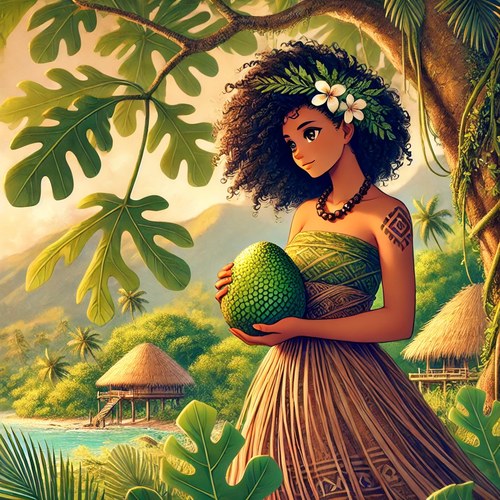
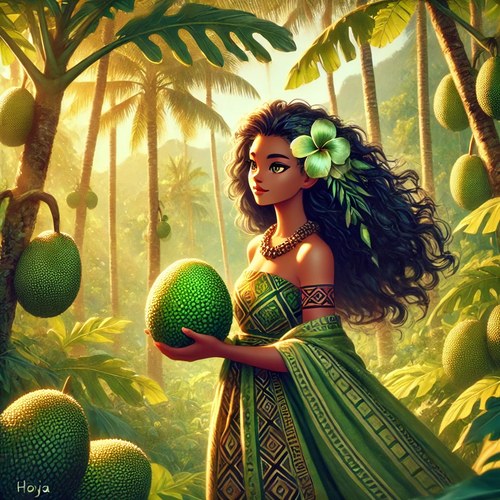
Breadfruit Moana Polynesia & Micronesia

Botanical vs. cultural: For Moana in Australia and Oceania, breadfruit is framed through the Pacific/Malesian-New Guinea breadfruit complex and Pacific tree-crop agroforestry rather than Caribbean transplantation.

Narrative: Moana's route with Breadfruit is not linear. Moana moves between cultivation, preservation, market exchange, and household teaching, revealing how Breadfruit's origin is made through practice as much as geography.

Origin: Moana's story places Breadfruit in conversation with Polynesia & Micronesia. Moana's task is to hold Breadfruit's routes, uses, and caretakers together without collapsing them into one simplified origin claim.

Notes: Breadfruit in this Oceania entry returns to Pacific tree-crop knowledge: canopy, starch, fermentation, shade, and agroforestry abundance.

Ulu (Hawaiian Breadfruit) Ulani Hawaii & Pacific Islands

Botanical vs. cultural: Botanical/cultigen origin: Pacific breadfruit complex. Cultural significance: Hawaiian and Pacific agroforestry, abundance, shade, and starch security.

Narrative: In the Demystifying Food Origins universe, Ulani appears in breadfruit groves when Ulu (Hawaiian Breadfruit) is ready to be gathered, cooked, stored, or remembered. Their path turns Ulu (Hawaiian Breadfruit) into evidence of climate, care, and cultural decision-making.

Origin: Ulani's first scene begins with a tree canopy, a season of ripening, and the long memory of orchards or groves. The guardian is anchored in Hawaii & Pacific Islands, but the story keeps origin open enough to include migration, exchange, and local stewardship.

Notes: Ulu is abundance organized as tree canopy. It provides starch, shade, wood, mulch, and agroforestry structure.

Tahitian Lime Tangaroa French Polynesia & Pacific

Botanical vs. cultural: Botanical note: Tahitian/Persian lime is a hybrid citrus, not a simple Polynesian native crop. This entry treats French Polynesia/Pacific circulation as cultural and horticultural anchor.

Narrative: Tangaroa's story follows Tahitian Lime through reef-to-ridge gardens, where taste is inseparable from land use, season, and inherited technique. The guardian asks viewers to see Tahitian Lime as an archive of choices made across generations.

Origin: For Tangaroa, origin is not a single discovery moment. It is a chain of growers, cooks, seed keepers, and landscapes that made Tahitian Lime meaningful in relation to French Polynesia & Pacific.

Notes: Tahitian lime belongs to movement: hybrid citrus genetics, island horticulture, maritime exchange, and preservation through acidity.

Every purchase loops back

From Guardian to Garden

60% of proceeds are reinvested directly into community-controlled programs — including the farming and garden work these guardians celebrate.

Back to all regions
Support the work